Thursday, July 14, 2022

Revelation 4:9-11: "The Issue is Worship"

Revelation 4:9  And when those beasts give glory and honour and thanks to him that sat on the throne, who liveth for ever and ever, 

Revelation 4:10  The four and twenty elders fall down before him that sat on the throne, and worship him that liveth for ever and ever, and cast their crowns before the throne, saying, 

Revelation 4:11  Thou art worthy, O Lord, to receive glory and honour and power: for thou hast created all things, and for thy pleasure they are and were created. 

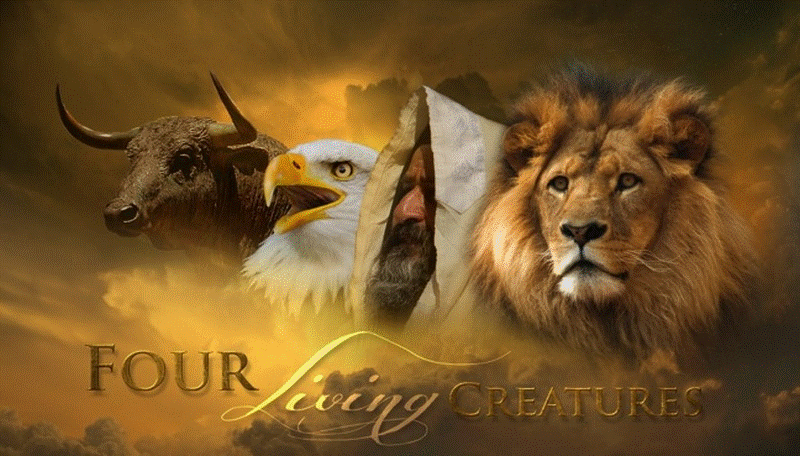
In the last two posts, we examined the images of the four beasts who are flying around the throne, the twenty-four elders who are seated around the throne, and most importantly The One who is sitting on the throne.  We have looked at what Old Testament passages this description references back to and some possible significances of what some of the descriptions mean.

But as we were finishing up the last Bible study, this ending section jumped out at me as the most important part of the chapter, and one that could possibly set the trajectory for and change someone's life and perspective.  I realized through people's comments as we were ending the study that what is said in worship here is the key to whether or not we are going to go the way of the Lamb and of the four beasts who fly around the Throne, or the way of the Dragon and the many-headed beast that appears later in the book.  The whole issue comes down to who is worthy.

We discussed in the last post how incredible it is that these magnificent, incredible creatures (whom I identify as the cherubim from Ezekiel's visions) are completely in tune with where the spirit wants to go.  And in this chapter that is especially emphasized.  These beasts realize that the truly worthy one is the One on the throne who lives forever and ever.  They are created--He is the Creator!  And they give glory, honor, and thanks to Him!

But we know that not every spiritual being or even every cherub has always reflected that attitude.

Ezekiel 28:11  Moreover the word of the LORD came unto me, saying, 

Ezekiel 28:12  Son of man, take up a lamentation upon the king of Tyrus, and say unto him, Thus saith the Lord GOD; Thou sealest up the sum, full of wisdom, and perfect in beauty. 

Ezekiel 28:13  Thou hast been in Eden the garden of God; every precious stone was thy covering, the sardius, topaz, and the diamond, the beryl, the onyx, and the jasper, the sapphire, the emerald, and the carbuncle, and gold: the workmanship of thy tabrets and of thy pipes was prepared in thee in the day that thou wast created. 

Ezekiel 28:14  Thou art the anointed cherub that covereth; and I have set thee so: thou wast upon the holy mountain of God; thou hast walked up and down in the midst of the stones of fire. 

Ezekiel 28:15  Thou wast perfect in thy ways from the day that thou wast created, till iniquity was found in thee. 

Ezekiel 28:16  By the multitude of thy merchandise they have filled the midst of thee with violence, and thou hast sinned: therefore I will cast thee as profane out of the mountain of God: and I will destroy thee, O covering cherub, from the midst of the stones of fire. 

Ezekiel 28:17  Thine heart was lifted up because of thy beauty, thou hast corrupted thy wisdom by reason of thy brightness: I will cast thee to the ground, I will lay thee before kings, that they may behold thee. 

Ezekiel 28:18  Thou hast defiled thy sanctuaries by the multitude of thine iniquities, by the iniquity of thy traffick; therefore will I bring forth a fire from the midst of thee, it shall devour thee, and I will bring thee to ashes upon the earth in the sight of all them that behold thee. 

Ezekiel 28:19  All they that know thee among the people shall be astonished at thee: thou shalt be a terror, and never shalt thou be any more. 

Notice what happened in the heart of this anointed, covering cherub.  What are some things we can pull out of this section that drew away this perfect, beautiful creature from what it was created to do?  What iniquity was found in him?

Now this can be a difficult passage to parse out, because we seem to be talking about the fall of an angelic being, but also the king of Tyre, but also the city of Tyre.  But try to enter into what the prophet is doing.  He is conflating these three concepts, and by doing so, he can show the spiritual similarities between the city of Tyre and the spiritual being who is behind the governing of the city, which is also behind the governing of many cities and nations in our world, and maybe even in our own heart.  But what are the things that the prophet identifies as problems?

  • The multitude of merchandise led to violence
  • Your heart was lifted up because of your beauty
  • Your wisdom is corrupted by reason of YOUR brightness
This creature is incredible.  Beautiful stones, musical instruments, wisdom, etc.  But all those benefits, all that significance, all that busyness and merchandise...that can make us start to think that it is all about us.  If it happened to the covering cherub, it can happen to us.

But what about the attitude of the cherubim who didn't fall?  Who weren't obsessed with their own worthiness, and instead recognized the worthiness of the One who sits on the Throne?  Why, when the four beasts give glory and honour and thanks to him that sat on the throne, who liveth for ever and ever, look what happens!

Revelation 4:10  The four and twenty elders fall down before him that sat on the throne, and worship him that liveth for ever and ever, and cast their crowns before the throne,

It's as if one act of worship inspires another!  I've seen this in church services, myself!  Extravagant, genuine praise tends to be contagious.  I've felt it!  When I see a heartfelt, sincere act of worship, it makes me want to worship!  I remember seeing people in a church in Nicaragua with no air conditioning, just open windows to let in the breeze, and they were all dancing before the Lord in such an enthusiastic way, that I fell down in my suit on the dirty, concrete floor and began praising God with my face to the ground, just because of the worship I saw being given to Him.  Isn't it amazing that our praise can have that kind of an effect?

The elders are in their rightful places, after all.  They have overcome, and now they are a royal priesthood, ruling and reigning with Christ, just as He promised.  These crowns were given to them by Him, after all!  But in His presence, all they can do is take those crowns that were given and throw them before the throne.  As my wife said in the Bible study, how can we wear these crowns when we know it was all because of Him that we even have them in the first place?  All we have to offer is what He has given, so we throw the crowns before Him. 

Many haven't been willing to throw their crowns before Him though...  Saul and Herod come to mind.  The question is who is worthy of those crowns?  The twenty-four elders have an answer.

Revelation 4:11  Thou art worthy, O Lord, to receive glory and honour and power: for thou hast created all things, and for thy pleasure they are and were created. 

It all comes to the question of who is worthy and what we were created for.  Who do we consider worthy to receive glory and honor and power?  Do we think that WE are worthy of those things?  The issue really does come down to what has the most worth in our lives.  This will determine our eternal destiny.  You may have heard that the word "worship" comes from the idea of "worth-ship."

Old English worðscip, wurðscip (Anglian), weorðscipe (West Saxon) "condition of being worthy, dignity, glory, distinction, honor, renown," from weorð "worthy" (see worth) + -scipe (see -ship). Sense of "reverence paid to a supernatural or divine being" is first recorded c. 1300. The original sense is preserved in the title worshipful "honorable" (c. 1300).

(https://www.etymonline.com/word/worship)

This is the Greek word...

G4352 προσκυνέω proskuneō 

Thayer Definition:

1) to kiss the hand to (towards) one, in token of reverence

2) among the Orientals, especially the Persians, to fall upon the knees and touch the ground with the forehead as an expression of profound reverence

3) in the NT by kneeling or prostration to do homage (to one) or make obeisance, whether in order to express respect or to make supplication

3a) used of homage shown to men and beings of superior rank

Part of Speech: verb; A Related Word by Thayer’s/Strong’s Number: from G4314 and a probable derivative of G2965 (meaning to kiss, like a dog licking his master’s hand)

Do you recoil at the idea of worship being like a dog licking it's master's hand?  The Syro-Phonecian woman in Matthew 15 may have some things to teach us about that mindset...

The end of Romans chapter 1 describes society off the rails, listing every kind of sin and perversion you can imagine.  How did it all get this way?  You have to trace it back in Romans chapter 1 and realize that ultimately, it is a problem with worship.

Romans 1:20  For the invisible things of him from the creation of the world are clearly seen, being understood by the things that are made, even his eternal power and Godhead; so that they are without excuse: 

Romans 1:21  Because that, when they knew God, they glorified him not as God, neither were thankful; but became vain in their imaginations, and their foolish heart was darkened. 

Romans 1:22  Professing themselves to be wise, they became fools, 

Romans 1:23  And changed the glory of the uncorruptible God into an image made like to corruptible man, and to birds, and fourfooted beasts, and creeping things. 

Romans 1:24  Wherefore God also gave them up to uncleanness through the lusts of their own hearts, to dishonour their own bodies between themselves: 

Romans 1:25  Who changed the truth of God into a lie, and worshipped and served the creature more than the Creator, who is blessed for ever. Amen. 

Romans 1:26  For this cause God gave them up unto vile affections: for even their women did change the natural use into that which is against nature: 

Romans 1:27  And likewise also the men, leaving the natural use of the woman, burned in their lust one toward another; men with men working that which is unseemly, and receiving in themselves that recompence of their error which was meet. 

Romans 1:28  And even as they did not like to retain God in their knowledge, God gave them over to a reprobate mind, to do those things which are not convenient; 

Romans 1:29  Being filled with all unrighteousness, fornication, wickedness, covetousness, maliciousness; full of envy, murder, debate, deceit, malignity; whisperers, 

Romans 1:30  Backbiters, haters of God, despiteful, proud, boasters, inventors of evil things, disobedient to parents, 

Romans 1:31  Without understanding, covenantbreakers, without natural affection, implacable, unmerciful: 

Romans 1:32  Who knowing the judgment of God, that they which commit such things are worthy of death, not only do the same, but have pleasure in them that do them. 

All the sins of the last several verses come from the root problem of worshipping and serving the creature more than the Creator.  We have to get a revelation of what we were created for!  What is the answer in Revelation 4:11?

Revelation 4:11  Thou art worthy, O Lord, to receive glory and honour and power: for thou hast created all things, and for thy pleasure they are and were created. 

I'll be honest, it's tempting to recoil at this.  Why were we created?  Just for God's pleasure?  How self-absorbed!  But we don't understand what brings God pleasure.  When we think of pleasure, oftentimes our minds go to self-indulgent, selfish pleasures.  (At least that's my initial thought...you readers are probably better people than me!)  But what gives God pleasure?  Let's look at a couple of verses that discuss what pleases the Lord.

Numbers 24:1  And when Balaam saw that it pleased the LORD to bless Israel, he went not, as at other times, to seek for enchantments, but he set his face toward the wilderness. 

Judges 13:23  But his wife said unto him, If the LORD were pleased to kill us, he would not have received a burnt offering and a meat offering at our hands, neither would he have shewed us all these things, nor would as at this time have told us such things as these. 

1st Samuel 12:22  For the LORD will not forsake his people for his great name's sake: because it hath pleased the LORD to make you his people. 

1st Kings 3:9  Give therefore thy servant an understanding heart to judge thy people, that I may discern between good and bad: for who is able to judge this thy so great a people? 
1st Kings 3:10  And the speech pleased the Lord, that Solomon had asked this thing. 

1st Chronicles 29:17  I know also, my God, that thou triest the heart, and hast pleasure in uprightness. As for me, in the uprightness of mine heart I have willingly offered all these things: and now have I seen with joy thy people, which are present here, to offer willingly unto thee. 

Ezra 10:11  Now therefore make confession unto the LORD God of your fathers, and do his pleasure: and separate yourselves from the people of the land, and from the strange wives. 

Psalm 5:4  For thou art not a God that hath pleasure in wickedness: neither shall evil dwell with thee. 

Psalm 35:27  Let them shout for joy, and be glad, that favour my righteous cause: yea, let them say continually, Let the LORD be magnified, which hath pleasure in the prosperity of his servant. 

Psalm 51:16  For thou desirest not sacrifice; else would I give it: thou delightest not in burnt offering. 
Psalm 51:17  The sacrifices of God are a broken spirit: a broken and a contrite heart, O God, thou wilt not despise. 
Psalm 51:18  Do good in thy good pleasure unto Zion: build thou the walls of Jerusalem. 
Psalm 51:19  Then shalt thou be pleased with the sacrifices of righteousness, with burnt offering and whole burnt offering: then shall they offer bullocks upon thine altar. 

Psalm 69:30  I will praise the name of God with a song, and will magnify him with thanksgiving. Psalm 69:31  This also shall please the LORD better than an ox or bullock that hath horns and hoofs. 

Psalm 147:11  The LORD taketh pleasure in them that fear him, in those that hope in his mercy. 

Psalm 149:4  For the LORD taketh pleasure in his people: he will beautify the meek with salvation. 

I could go on, but are you getting the picture of what really pleases the Lord, of what it really means that God created us for His pleasure?  When will we realize that when we seek His pleasure rather than our own, it really has the best outcome for us?

We were made for Him, not the other way around.  It is time that we ascribed more worth to our Creator than to ourselves and recognize that His pleasure is far more important than ours.  That revelation will set the tone for the rest of our lives.

Revelation 4:6-8: "The Carriers of God's Glory"

 As we continue to explore the throne room scene in Revelation chapter 4, things start getting weirder.  But only if you don't know the Old Testament prophets very well.  The images that John sees would be very familiar to people who were familiar with Isaiah and Ezekiel and any time one of the Hebrew prophets sees God on His Throne, really.  If you're already familiar, you may be able to skip this post, and just read the text and feel the scene.  But if you don't know what I'm talking about, let's explore this scene a little bit more.

Revelation 4:6  And before the throne there was a sea of glass like unto crystal: and in the midst of the throne, and round about the throne, were four beasts full of eyes before and behind. 

A sea of glass like unto crystal is before the Throne.  This might seem odd, but, again, it's calling to mind other experiences people have had with God on His Throne.  We just read that there are 24 elders around the throne.  Well, when Israel was becoming a nation, after the covenant had been made, and the blood of the covenant had been sprinkled on the people, God invited seventy of the elders of the children of Israel partway up the mountain, and we see something powerful.

Exodus 24:9  Then went up Moses, and Aaron, Nadab, and Abihu, and seventy of the elders of Israel: 

Exodus 24:10  And they saw the God of Israel: and there was under his feet as it were a paved work of a sapphire stone, and as it were the body of heaven in his clearness. 

Exodus 24:11  And upon the nobles of the children of Israel he laid not his hand: also they saw God, and did eat and drink. 

You might say, well that is not the same description!  Maybe not, but it is interesting that before the throne of God the elders of Israel saw a paved work like sapphire, so we get this idea of a blueish stone, but the word for "paved work" is interesting.  This is the only time in the Hebrew Bible the word is used, and this is how Strong's defines it...

H3840 לִבְנָה libnâh lib-naw'

From H3835; properly whiteness, that is, (by implication) transparency: - paved.

Total KJV occurrences: 1

So even though it's described as a paved work, it has the idea of transparency associated with it...as does glass and crystal in John's description in Revelation.  And Exodus goes on to make a direct parallel with this and the sky in its "clearness" (a word, which in other places is translated in a way that has to do with purity and glory).  Where is God's throne?  Heaven is God's throne, right?  It is fitting that His throne is on something that represents the sky.  And I can't help but feel that Solomon's Bronze Sea and the laver that was before the Tabernacle had some kind of reminiscence of what was seen here.  Clear, but blueish...what does that make you think of?  Like glass or crystal...  The sky?  Water?  God's Throne sits on this Pavement.  There is also a platform that God's Throne sits on in Ezekiel's vision, which is referred to as a "firmament", and described in Ezekiel 1:22 as the color of a "terrible crystal."

Ezekiel 1:22  And the likeness of the firmament upon the heads of the living creature was as the colour of the terrible crystal, stretched forth over their heads above. 

Ezekiel 1:26  And above the firmament that was over their heads was the likeness of a throne, as the appearance of a sapphire stone: and upon the likeness of the throne was the likeness as the appearance of a man above upon it. 

And if you're wondering about the bit about the firmament being on the heads of living creatures, we are just coming to that now.  In addition to the 24 elders, we also see in Revelation four beasts full of eyes that are apparently in the midst of and around the throne.  Well, Ezekiel also describes some creatures associated with God's throne that are full of eyes, but he also identifies them.

Ezekiel 10:12  And their whole body, and their backs, and their hands, and their wings, and the wheels, were full of eyes round about, even the wheels that they four had. 

So we see a "full of eyes" reference in Ezekiel and in Revelation.  But Revelation has more description.  Let's look at that and then jump back into the book of Ezekiel to find more parallels.

Revelation 4:7  And the first beast was like a lion, and the second beast like a calf, and the third beast had a face as a man, and the fourth beast was like a flying eagle.

So these creatures are compared to four specific things...a lion, a calf, a man, and a flying eagle.  Well, when we turn back to the book of Ezekiel, we see something quite similar.  And this is where we come back to this "firmament" that is over the heads of the living creatures.  To set the stage, Ezekiel is one of the captives that has been carried away from Jerusalem into Babylon.  The people of God are going through a crisis.  God said He would set His name in Jerusalem forever and this is where His Temple was located, where His presence would dwell.  He also made promises to the descendants of David and declared that one of David's descendants would always sit on the throne in Judah and that the kingdom of David would be everlasting.  But when Babylon comes in, the people are taken away from God's Presence at the Temple, and the descendant of David is carried off.  What are God's people supposed to make of this?  Later on, the Temple will be destroyed!  What about God's promised Presence?  Well, when the book of Ezekiel opens, we see him in Babylon by the river Chebar, and he sees some strange things.  He sees an amber-colored whirlwind with lightning and fire associated with it.  Coming out of the whirlwind he sees four living creatures.  Look at his description:

Ezekiel 1:5  Also out of the midst thereof came the likeness of four living creatures. And this was their appearance; they had the likeness of a man. 

Ezekiel 1:6  And every one had four faces, and every one had four wings. 

Ezekiel 1:7  And their feet were straight feet; and the sole of their feet was like the sole of a calf's foot: and they sparkled like the colour of burnished brass. 

Ezekiel 1:8  And they had the hands of a man under their wings on their four sides; and they four had their faces and their wings. 

Ezekiel 1:9  Their wings were joined one to another; they turned not when they went; they went every one straight forward. 

Ezekiel 1:10  As for the likeness of their faces, they four had the face of a man, and the face of a lion, on the right side: and they four had the face of an ox on the left side; they four also had the face of an eagle. 

Ezekiel 1:11  Thus were their faces: and their wings were stretched upward; two wings of every one were joined one to another, and two covered their bodies. 

Ezekiel 1:12  And they went every one straight forward: whither the spirit was to go, they went; and they turned not when they went. 

Ezekiel 1:13  As for the likeness of the living creatures, their appearance was like burning coals of fire, and like the appearance of lamps: it went up and down among the living creatures; and the fire was bright, and out of the fire went forth lightning. 

Ezekiel 1:14  And the living creatures ran and returned as the appearance of a flash of lightning.  

If you thought the description in Revelation 4 was odd, get a load of this! What a strange experience Ezekiel is having!  Though not as strange to him as you might suppose at first glance.  He goes on to describe how each creature also has a wheel associated with it, full of eyes, with a wheel within the wheel.  Then we get to the part I mentioned earlier.  These four creatures aren't simply coming alone.  SomeOne Else is with them.

Ezekiel 1:22  And the likeness of the firmament upon the heads of the living creature was as the colour of the terrible crystal, stretched forth over their heads above. 

Ezekiel 1:23  And under the firmament were their wings straight, the one toward the other: every one had two, which covered on this side, and every one had two, which covered on that side, their bodies. 

Ezekiel 1:24  And when they went, I heard the noise of their wings, like the noise of great waters, as the voice of the Almighty, the voice of speech, as the noise of an host: when they stood, they let down their wings. 

Ezekiel 1:25  And there was a voice from the firmament that was over their heads, when they stood, and had let down their wings. 

Ezekiel 1:26  And above the firmament that was over their heads was the likeness of a throne, as the appearance of a sapphire stone: and upon the likeness of the throne was the likeness as the appearance of a man above upon it. 

Ezekiel 1:27  And I saw as the colour of amber, as the appearance of fire round about within it, from the appearance of his loins even upward, and from the appearance of his loins even downward, I saw as it were the appearance of fire, and it had brightness round about. 

Ezekiel 1:28  As the appearance of the bow that is in the cloud in the day of rain, so was the appearance of the brightness round about. This was the appearance of the likeness of the glory of the LORD. And when I saw it, I fell upon my face, and I heard a voice of one that spake. 

In some strange way, these creatures are carriers of the glory of God.  They appear to be carrying the platform that the Throne of God is on.  What's amazing for the people Ezekiel is with is that the Throne of God is coming to THEM in Babylon.  They don't have to go to the Temple to interact with Him.  He is mobile, not stationary.  Ezekiel sees these same creatures in chapter 10, and describes them again, but there, in that chapter, he identifies what they are.

Ezekiel 10:14  And every one had four faces: the first face was the face of a cherub, and the second face was the face of a man, and the third the face of a lion, and the fourth the face of an eagle. 

Ezekiel 10:15  And the cherubims were lifted up. This is the living creature that I saw by the river of Chebar. 

Now that these things are associated with cherubim, some other Biblical passages may pop into your mind.  You may remember, for example, that there are cherubim on top of the ark of the covenant, which by no coincidence, is a symbol for the mobile throne of God, the carrier of God's glory.  But they aren't just on the Tabernacle.  They are also on the vail or curtain you have to go through to get to the Holy of Holies where the ark of the covenant was usually kept.  But they are also on the curtains of the Holy Place and the door that leads in there.  And if that wasn't enough, they're even depicted on the door that gains you access to the outer court where the sacrifices are made.  They're all over Solomon's Temple.  In other words, when you went to the Temple or the Tabernacle, the closest you got to God's glory, to His Presence, the more cherubim you would encounter.  Even the first place they are mentioned, as guardians at the entrance to the Garden of Eden, guarding the way to the Tree of Life, gives you a similar impression. These are magnificent, intimidating, powerful beings that are associated with God's Presence in a powerful way.  In Ezekiel they are used to show God's Presence as mobile (riding the chariot of the cherubim, as it's called in 1 Chronicles 28), leaving the Temple in Jerusalem and reaching the captives in Babylon.  But in Revelation, the platform and the Throne are at rest, and the living creatures are flying around the throne.  What do they do when they are not transporting God's Presence?

Revelation 4:8  And the four beasts had each of them six wings about him; and they were full of eyes within: and they rest not day and night, saying, Holy, holy, holy, Lord God Almighty, which was, and is, and is to come. 

Now, this is a little different from the description in Ezekiel.  In Ezekiel, the cherubim are described as having four wings.  Here, these creatures have six.  Could they be different creatures in heaven that the cherubim of Ezekiel are represented as?  Possibly.  This verse, however, should call to mind another scene from a prophet who is ushered into the throne room of God.

Isaiah 6:1  In the year that king Uzziah died I saw also the Lord sitting upon a throne, high and lifted up, and his train filled the temple. 

Isaiah 6:2  Above it stood the seraphims: each one had six wings; with twain he covered his face, and with twain he covered his feet, and with twain he did fly. 

Isaiah 6:3  And one cried unto another, and said, Holy, holy, holy, is the LORD of hosts: the whole earth is full of his glory. 

Isaiah 6:4  And the posts of the door moved at the voice of him that cried, and the house was filled with smoke. 

The seraphim and cherubim are generally classified as different kinds of angelic or spiritual beings, but it is so interesting that the descriptions seem to be combined in Revelation chapter 4.  I think one of the significant things about these creatures is that they are completely devoted and focused on their service to God.  What they cry out is fascinating as well.  In Hebrew, if you want to emphasize something you say it twice.  So in the KJV, if you see that the altar is "most holy" or that the room is the "most holy place" it is usually just the word "holy" repeated twice.  The altar is holy, holy.  And that's the way that it is usually emphasized.  There are holy things, and there are holy, holy things.  But two is the highest it goes...except for these passages.  Because the Lord God Almighty is not just holy, or even holy, holy, but He is HOLY, HOLY, HOLY!  This is the highest degree of holiness imaginable, and the entire description of the Throne Room should give us that understanding even before we reach this phrase.  This is praising God as He is, the I AM THAT I AM, the One Who Is, and Was, and Is To Come!  Eternal and Holy--God in His fulness.

As we reflect on these verses consider how amazing it is that God invites us to come boldly before the throne of grace.  Consider how amazing it is that He has the option of His glory being conveyed by these creatures which are compared with what are probably the creatures we think of as most majestic, powerful, and mighty (man, ox, eagle, lion), who never cease from praising Him, and who go only where the Spirit directs them to go, and yet, He chooses to have His glory carried by us.  That's a sobering and beautiful thought and one that we should think about and dwell on very carefully.


Proverbs 30:30  A lion which is strongest among beasts, and turneth not away for any; 

Proverbs 14:4  Where no oxen are, the crib is clean: but much increase is by the strength of the ox.

Job 39:27  Doth the eagle mount up at thy command, and make her nest on high? 
Job 39:28  She dwelleth and abideth on the rock, upon the crag of the rock, and the strong place. 

Genesis 1:27  So God created man in his own image, in the image of God created he him; male and female created he them.

Tuesday, July 12, 2022

Revelation 4:1-5: "The One on the Throne"

 In Revelation chapter 4, we transition to a different dimension.

Revelation 4:1  After this I looked, and, behold, a door was opened in heaven: and the first voice which I heard was as it were of a trumpet talking with me; which said, Come up hither, and I will shew thee things which must be hereafter. 

First of all, a door was opened in heaven.  Well, what does that mean?  A door means access.  John is going to be able to enter into a heavenly perspective, which is what we will see for the rest of the book.  This is key for our interpretation.  If we try to look at all the prophecies with simply an earthly point of view, we are going to get way off track and become hopelessly lost.  John entered into heaven to see things from a heavenly point of view.

Now, who calls him to come up?  He says it is the first voice which he heard.  I used to read that as if it was the first voice he happened to hear after the door was opened.  But, when I thought about it more, I realized that it's a callback to chapter 1!  Whose voice calls to him?  The first voice he heard, which sounded like a trumpet!  Remember?

Revelation 1:10  I was in the Spirit on the Lord's day, and heard behind me a great voice, as of a trumpet, 

We know who that voice belongs to, right?  We discussed at length in chapter 1.  This is a Revelation of Jesus Christ!  We're seeing Him as He is!  When the voice calls out of heaven in chapter 4, it is not a brand new voice, but rather a continuation of the voice that has been speaking from chapter 1 all the way through chapter 3!  But now it is inviting John to a higher vision.  A higher revelation.  Just as when God called to Moses up on Mount Sinai, inviting him up into the clouds, up into the heavens to see the throne of God, and heavenly visions, and to get a heavenly perspective, John is also being called up into heaven to see the things which shall be hereafter.  He was already told he was going to write about this, remember?

Revelation 1:19  Write the things which thou hast seen, and the things which are, and the things which shall be hereafter; 

He is now going to see those things which shall be hereafter so that he can write about them.

Revelation 4:2  And immediately I was in the spirit: and, behold, a throne was set in heaven, and one sat on the throne.

Now the question is, wasn't John already in the spirit?  He said he was, back in Revelation 1:10!  But there is some kind of transition here.  It's like when Ezekiel is in the spirit in chapters 3 and 8 of his book.  Ezekiel is transferred to a real place (Jerusalem), but he says he's caught up between heaven and earth.  I take that to mean that he is seeing things that are real on earth, but he's seeing what's really going on in the spirit.  I think something similar is happening to John here.  He is now in the heavenly throne room and the perspective has changed.  The first thing to make note of is that there is a throne.  And I have to point out...how many thrones are there?  One.  There are other seats that we'll see in a few verses, but there is clearly A THRONE that is set apart and distinct.  And ONE sits on the throne.  If you think you'll see anything other than One on the Throne, I think you're mistaken.  I firmly believe The One on the Throne is the Source of the voice which called John up to see.  The One on the Throne is the most significant thing about what John is going to see.  But there's more.

Revelation 4:3  And he that sat was to look upon like a jasper and a sardine stone: and there was a rainbow round about the throne, in sight like unto an emerald. 

A preacher I heard in Texas pointed out something really cool about this verse.  First off, let's get a picture of these stones in our minds.  I pulled this one which someone conveniently created off the Internet.


It's interesting that Ezekiel, when he describes the figure he sees on the throne usually uses the image of amber.

I can see the similarities between jasper, sardius, and amber.  So why wouldn't John describe it using the same stone as Ezekiel so as to take our minds back to that prophet?  I think John uses two stones to bring another passage of Scripture to our minds.  The high priest's breastplate is said to have 12 stones, representing the 12 tribes of Israel.  Notice in what position on the breastplate the jasper and sardius stones are.

Exodus 28:17  And thou shalt set in it settings of stones, even four rows of stones: the first row shall be a sardius, a topaz, and a carbuncle: this shall be the first row. 
Exodus 28:18  And the second row shall be an emerald, a sapphire, and a diamond. 
Exodus 28:19  And the third row a ligure, an agate, and an amethyst. 
Exodus 28:20  And the fourth row a beryl, and an onyx, and a jasper: they shall be set in gold in their inclosings. 

Did you catch it?  John describes the One who sits on the throne as looking like the last and the first stones in the high priest's ephod.  I think that's pretty cool.

But what about the rainbow encircling the throne?  We had a long talk in Bible study about what exactly this would look like, and I have to confess, I am completely at a loss for what it means when it describes the rainbow being in sight as an emerald.  However, the rainbow imagery isn't unique to John.

Ezekiel 1:26  And above the firmament that was over their heads was the likeness of a throne, as the appearance of a sapphire stone: and upon the likeness of the throne was the likeness as the appearance of a man above upon it. 
Ezekiel 1:27  And I saw as the colour of amber, as the appearance of fire round about within it, from the appearance of his loins even upward, and from the appearance of his loins even downward, I saw as it were the appearance of fire, and it had brightness round about. 
Ezekiel 1:28  As the appearance of the bow that is in the cloud in the day of rain, so was the appearance of the brightness round about. This was the appearance of the likeness of the glory of the LORD. And when I saw it, I fell upon my face, and I heard a voice of one that spake. 

And, of course, what should we be thinking of, when we hear of the brightness having an appearance as the bow that is in the cloud in the day of rain?

Genesis 9:14  And it shall come to pass, when I bring a cloud over the earth, that the bow shall be seen in the cloud: 
Genesis 9:15  And I will remember my covenant, which is between me and you and every living creature of all flesh; and the waters shall no more become a flood to destroy all flesh. 
Genesis 9:16  And the bow shall be in the cloud; and I will look upon it, that I may remember the everlasting covenant between God and every living creature of all flesh that is upon the earth. 

I think it is a powerful truth that the throne of God is encircled by the token of the everlasting covenant God made with all flesh.  His throne is surrounded by this covenant of mercy.  His throne is surrounded by His promise.  He has to look through the token of His covenant to see us, and we have to look through the token of His covenant to see Him.  It surrounds His throne.  That is such a powerful image to me.

Revelation 4:4  And round about the throne were four and twenty seats: and upon the seats I saw four and twenty elders sitting, clothed in white raiment; and they had on their heads crowns of gold. 

Now we see one of the most intriguing and mysterious elements of the throne room scene.  Who are these 24 elders?  Why 24?  We know that the term elder is significant all throughout Scripture as an overseer or ruler or pastor or someone who sits in the city gates to make decisions or leads a congregation in the New Testament church.  We see 70 elders come up the mountain to see God on the Throne on Sinai in Exodus 24 who eat and drink before Him, in one beautiful moment before things crash with the Golden Calf story.  We know that God wants to partner with His creation to rule.  We see in Daniel 7's throne room scene that God desires to give dominion and authority and the kingdom to the saints of the Most High.  But what is the deal with 24?  It can't be an accident that 24 is two groups of 12.  We can immediately think of groups of 12.  After all, there were 12 tribes of Israel, and Jesus chose The Twelve Apostles.  But who then are these elders?  Is John seeing himself as one of the twelve apostles on one of the 24 thrones?  Is it really the 12 sons of Jacob ruling here?  We do know that Jesus told The Twelve, that in the regeneration they would sit on 12 thrones judging the 12 tribes of Israel.  Does that play into anything here?  

We can think of lots of significance to 12, but is there anywhere in the Bible that a group of 24 people is significant?  I'm not the first to point out that 24 becomes a significant number in a part of the Bible we generally like to skim over, 1st Chronicles 24-27.  There, we see that David is preparing the ministry of the temple that Solomon is going to build.  The various families of the Levites had certain jobs passed on to them from the time of Moses relating to the Tabernacle.  But now a Temple is being built, and everything is changing for them.  They do not lose their calling, however.  David just groups them by lots to serve in the Temple, whether the Levites who are serving in the Temple as priests or the singers and musicians who are serving in worship.  Any guesses as to how many divisions there are?  Ding, ding, ding!  Twenty-four.  Isn't it interesting that we see 24 seats represented in the heavenly throne room where worship is happening day and night in Revelation chapter 4?

What other clues do we have about the identities of these elders?  Well, they're clothed in white raiment.  I seem to recall a group being promised white raiment very recently in Revelation...

Revelation 3:5  He that overcometh, the same shall be clothed in white raiment; and I will not blot out his name out of the book of life, but I will confess his name before my Father, and before his angels. 

They also wear crowns.  I seem to also recall a group being promised crowns fairly recently in the text...

Revelation 2:10  Fear none of those things which thou shalt suffer: behold, the devil shall cast some of you into prison, that ye may be tried; and ye shall have tribulation ten days: be thou faithful unto death, and I will give thee a crown of life. 

When I think of white raiment, I think of priests.  And when I think of crowns, I think of kings.  The combination of those things makes me think of Revelation 1:6.

Revelation 1:6  And hath made us kings and priests unto God and his Father; to him be glory and dominion for ever and ever. Amen. 

If we see the 24-fold division of priests seated around the Throne of God, wearing crowns, we seem to have a royal priesthood, ruling and reigning with the One on the Throne, wouldn't you say?  I don't think we can be dogmatic about who these 24 elders are, but it is very interesting to consider all these different elements.

One last element to consider, which I love, is that they are around the throne, just as the rainbow is around the throne.  I used to picture this throne room as we have our churches set up, with a stage or dais with The Throne on it, and the elders seated in front.  But that's not what it says.  It's much more like the old synagogues were, which had the person reading the text of Scripture in the center of the room, and everyone gathered on seats round about them.  The point of that synagogue set-up was that the Scripture was central and they were all gathered around it.  And I love that The Throne is central in this scene, and everything is gathered around Him.  Jesus is the center of it all.

Revelation 4:5  And out of the throne proceeded lightnings and thunderings and voices: and there were seven lamps of fire burning before the throne, which are the seven Spirits of God. 

Again, this description mirrors the description given of Mount Sinai in Exodus 19.

Exodus 19:16  And it came to pass on the third day in the morning, that there were thunders and lightnings, and a thick cloud upon the mount, and the voice of the trumpet exceeding loud; so that all the people that was in the camp trembled. 

This is where the presence of God is located!  I won't rehash what we've already talked about with the seven lamps of fire before the throne, which are the seven spirits of God, except to say that it is interesting that when Moses ascended Mount Sinai, he got the instructions for how to build the Tabernacle, and was told very explicitly to make everything after the pattern that was shown to him on the mountain.  (Hebrews chapter 8 riffs on that concept quite a bit.)  And one of the first things Moses is told to make is a candlestick with seven flames of fire.  Something to think about.

This was as far as we were able to get in one Bible study.  But there is such a power to these images.  I encourage everyone, as they think about the things going on in the world and the instability and fear that is propounded all the time, to remember this scene.  There is still a Throne in Heaven, and there is still One who sits on the Throne.  The token of the covenant surrounds His Throne, and He is central to all the figures who rule and reign with Him.  He is the King of kings and the Lord of lords.  Let's always remember as we grow uncomfortable with our earthly perspective of how things are going to take a step back and remember the perspective we got when the door was opened in heaven and we saw The One who Sits on the Throne.

Sunday, May 29, 2022

Revelation 1:8-18: "Jesus Has White Hair?"

Revelation 1:8  I am Alpha and Omega, the beginning and the ending, saith the Lord, which is, and which was, and which is to come, the Almighty. 

When you usually picture Jesus, I bet the description from Revelation chapter 1 is generally not the first thing that comes to your mind. 

(Unfortunately, when we picture Jesus nowadays, it usually isn't the Jesus from the gospels either, because we've been so influenced by Renaissance painters, but I digress...)

I have spent several blog posts breaking down the phrases from the introduction of Revelation, because they are so theologically rich, and really beneficial for our understanding of the gospel as we approach Revelation.  There's a reason John started with that introduction as we embark on the vision of the book.  We saw that through frequent allusions to the rest of the Scriptures, John painted a vivid picture of who Jesus is and who we are as the church.  That is the basis for reading this book.  But now, we get into the meat of the book.  Verses 1-8 are all intro.  Now, we get to start experiencing along with John what he experienced on the Isle of Patmos.

First, we get John giving us the context for his revelation.  

Revelation 1:9  I John, who also am your brother, and companion in tribulation, and in the kingdom and patience of Jesus Christ, was in the isle that is called Patmos, for the word of God, and for the testimony of Jesus Christ. 

Though we don't have all the exact details, we see how he is setting the stage.  John, (and I do believe this is the Apostle John, brother of James, son of Zebedee, one of the original 12 disciples), has outlasted all the other apostles up to this point.  His brother, James, was the first of the 12 to die (aside from Judas Iscariot), killed in Acts chapter 12 by Herod.  The rest of the apostles took longer, but eventually, it seems they all died a martyr's death.  Peter and Paul were put to death in Nero's persecution in the 60s.  Foxe's book of Martyrs has some interesting accounts of some of the other big names of the New Testament church, and how they died, Andrew being hung on an X-shaped cross, preaching for days before dying, James, the half-brother of Jesus, being thrown from the pinnacle of the temple then beaten to death, Thomas killed by a spear, Matthew meeting a similar end...one by one, all the early leaders of the church were killed in one way or another, by one group or another, and the leadership of the church passed on to the next generation of their disciples.

But John lived on, one of the last apostles to survive, one of the last original voices to speak strongly for who Jesus was as an eyewitness and to fight against the false teaching that was encroaching on the church in the decades after the beginning of the church.  There was probably a brief respite from the Roman government after Nero, as they dealt with political turmoil (though many groups would have been none too happy about the followers of Jesus).  But by the time John writes his gospel, epistles, and Revelation, the emperor Domitian, an embittered and once-passed-over younger brother of Titus who had destroyed the Temple, had come to the throne and was determined to be respected.  He initiated a new wave of persecution, which John probably got caught up in.

Tertullian tells us that John was plunged into boiling oil, but was unhurt, and thus, was exiled to the small penal colony of Patmos.  It is interesting, that in writing to the area of Asia Minor which he was spiritually responsible for, (according to church history), he starts by reminding them that he is their brother, and companion in tribulation.  He is not lording anything over them.  Jesus is Lord; John is a brother and companion of the people he is writing to.  He works for the same kingdom and must endure with patience for the sake of his Savior just like them.  He is not immune because he is a leader--far from it.  This is a body, a fellowship, and he is one of us.  The very reason he is on Patmos is that he insists on sharing his testimony of Jesus Christ, and will uphold the Word of God no matter what.  Our priorities should be no different.  No matter what the last days may hold for us, no matter what our view ends up being as we study this incredible book, the Word of God, and the Testimony of Jesus Christ should be our paramount priorities.  This is the same John who, along with Peter, gave us this example, when they were being told by the authorities not to speak at all nor teach in the name of Jesus:

Acts 4:19  But Peter and John answered and said unto them, Whether it be right in the sight of God to hearken unto you more than unto God, judge ye. 

Acts 4:20  For we cannot but speak the things which we have seen and heard. 

Now John has been exiled from his community and his flock for continuing to preach the truth that he has been preaching from the beginning.  It was interesting that the last Bible study I participated in with a group before the Covid-19 shut-downs in 2020 was through Revelation chapter 1.  We drew great encouragement from John, who, though he was exiled away from his church, was able to draw nigh to God and receive one of the greatest Revelations the world has ever received.

Revelation 1:10  I was in the Spirit on the Lord's day, and heard behind me a great voice, as of a trumpet, 

John, all by himself in his exile, does what every Christian should do every day.  Gets in the Spirit.  He is worshipping.  And it says it is "the Lord's day", which I believe to be Sunday, the first day of the week, because I believe that's when the early church met.  Whether it is or not, we see that John didn't let not having a congregation stop him from getting in the Presence of the Lord.  And only when that happens can we hear the voice of the Lord.  An important thing to note about this Scripture is also this: when John received the Revelation, he was in the Spirit.  How are we to understand it, if we are not also in the Spirit?  This is a spiritual book, and we must treat it as such.

Revelation 1:11  Saying, I am Alpha and Omega, the first and the last: and, What thou seest, write in a book, and send it unto the seven churches which are in Asia; unto Ephesus, and unto Smyrna, and unto Pergamos, and unto Thyatira, and unto Sardis, and unto Philadelphia, and unto Laodicea. 

So let's set the stage here.  John is praying and worshipping on this island where he has been exiled, and suddenly, as he is in the Spirit, he hears a voice like a trumpet blasting behind him.  Now that's already startling, and we already have an inkling of who this voice belongs to, don't we?  If we are in the Spirit and hear a voice like a trumpet, who are we expecting? What does this voice like a trumpet remind us of?  We'll have a lot more to say about trumpets as we continue through the book of Revelation, but I do want to draw attention to one Old Testament passage where the phrase is used...

Exodus 19:16  And it came to pass on the third day in the morning, that there were thunders and lightnings, and a thick cloud upon the mount, and the voice of the trumpet exceeding loud; so that all the people that was in the camp trembled. 

Exodus 19:17  And Moses brought forth the people out of the camp to meet with God; and they stood at the nether part of the mount. 

Exodus 19:18  And mount Sinai was altogether on a smoke, because the LORD descended upon it in fire: and the smoke thereof ascended as the smoke of a furnace, and the whole mount quaked greatly. 

Exodus 19:19  And when the voice of the trumpet sounded long, and waxed louder and louder, Moses spake, and God answered him by a voice. 

I can't help but think of scenes like this when I read Revelation chapter 1.  Exodus 19 is one of the greatest revelations of Himself that God gave to His people, and I think we're seeing another one here.  We get the Voice identifying itself, as we got in verse 8... "I am Alpha and Omega."  Those are the first and last letters of the Greek alphabet.  We could say He is the A and the Z in English, or the Aleph and the Tau in Hebrew.  He is the first and the last.  Now where have we seen phrasing like that before?

Isaiah 41:4  Who hath wrought and done it, calling the generations from the beginning? I the LORD, the first, and with the last; I am he. 

This isn't just anyone...this can only be the LORD, YHWH HIMSELF, who has this kind of title.  Who else COULD be first and last except The Only Eternal One?  It is also interesting that this chapter of Isaiah is in a global context, calling out to the islands...  Again:

Isaiah 44:6  Thus saith the LORD the King of Israel, and his redeemer the LORD of hosts; I am the first, and I am the last; and beside me there is no God. 

Connecting this to Isaiah seems to make it pretty emphatic about who is talking here.  Some versions don't have these phrases in this verse, which is a shame, but we do see the phrase repeated in verse 17, so the phrase is associated with the speaker in Revelation 1.  This title is unique, as is the title Almighty in verse 8.  How many Almighties can there be?  I submit to you that there can be only one.  And the Alpha and Omega has an assignment for John.  John is going to see these things and he is tasked with sending the account of what he has seen to the seven churches of Asia. (We will, of course, be getting more into the specifics of each of these churches in chapters 2 and 3.)

Revelation 1:12  And I turned to see the voice that spake with me. And being turned, I saw seven golden candlesticks; 

Now again, picture the scene.  John hears the voice from behind him, so naturally, he turns to see who is speaking.  But the first thing he sees is seven golden candlesticks.  Now I've tried to set up some things about the candlesticks in the post on the Seven Spirits of God in Revelation 1:4, and we'll be getting more of that in the explanation of the candlesticks in Revelation 1:20.  But, here, I want us to think of what our first association should be with this.  Where does one usually see seven golden candlesticks?  If you said in the Tabernacle or the Temple, ding, ding, ding! You are correct!  This is a link to bring us into the Holy Place, which is where the candlestick was to be set up.  Remember that in Exodus when Moses was being told how to build the Tabernacle, the third thing he was told of, after the ark of the covenant and the table of the bread of the presence was the candlestick...

Exodus 25:31  And thou shalt make a candlestick of pure gold: of beaten work shall the candlestick be made: his shaft, and his branches, his bowls, his knops, and his flowers, shall be of the same. ...00

Exo 25:37  And thou shalt make the seven lamps thereof: and they shall light the lamps thereof, that they may give light over against it. 

And remember what Moses is reminded of immediately after the instructions on how to make the candlestick...

Exodus 25:40  And look that thou make them after their pattern, which was shewed thee in the mount. 

Moses was basing this on what he had seen in his own revelation. The physical candlestick was a representation of something going on in the spiritual realm in the heavenlies.

Exodus 40:24  And he put the candlestick in the tent of the congregation, over against the table, on the side of the tabernacle southward. 

Exodus 40:25  And he lighted the lamps before the LORD; as the LORD commanded Moses. 

The candlestick was placed in the Holy Place where only the priests could go.  So already, John is seeing something beyond the first veil, deeper than what the ordinary Israelite could have seen. He is seeing into the Holy Place.

Revelation 1:13  And in the midst of the seven candlesticks one like unto the Son of man, clothed with a garment down to the foot, and girt about the paps with a golden girdle. 

So first John sees the candlesticks, then IN THE MIDST of the candlesticks, he sees one like the Son of Man.  Now, hopefully, I made a big enough deal about the connection with the Son of Man from Daniel chapter 7 in my post on Revelation 1:7, the Pierced Cloud-Rider, that this phrase instantly jumps out at you.  One like the Son of man, the same phrase Daniel uses in his vision to describe the human figure who receives power and authority from the Ancient of Days, which is the phrase Jesus used most often when referring to himself.  But look at how he's dressed.  A modest, long garment down to the foot.  And he has a girdle on.  But this girdle is made of gold, and instead of where girdles usually go, around the loins, this one is around his waist.  Why is that so significant?  Well, the whole purpose of a girdle is to bind up the robes to make you ready for action.  "Gird up your loins like a man," is the phrase God used to Job.  That's where the sword would be kept (but, ah, the Son of man seems to keep his sword in a different place...), that's how they would become ready for action, to work, to run, to fight.  Yet, this girdle is around his chest, which seems to be more ceremonial, indicating, perhaps that the action has already taken place, and that the battle has already been won.  In Bible study, we took to calling this the championship belt.  And the ceremonial nature of this, connected with the golden candlesticks, HAS to bring my mind to the garments of the priests...

Exodus 28:4  And these are the garments which they shall make; a breastplate, and an ephod, and a robe, and a broidered coat, a mitre, and a girdle: and they shall make holy garments for Aaron thy brother, and his sons, that he may minister unto me in the priest's office. 

Exodus 28:8  And the curious girdle of the ephod, which is upon it, shall be of the same, according to the work thereof; even of gold, of blue, and purple, and scarlet, and fine twined linen. 

Exodus 28:22  And thou shalt make upon the breastplate chains at the ends of wreathen work of pure gold. 

Exodus 28:23  And thou shalt make upon the breastplate two rings of gold, and shalt put the two rings on the two ends of the breastplate. 

Exodus 28:24  And thou shalt put the two wreathen chains of gold in the two rings which are on the ends of the breastplate. 

Exodus 28:42  And thou shalt make them linen breeches to cover their nakedness; from the loins even unto the thighs they shall reach: 

Exodus 28:43  And they shall be upon Aaron, and upon his sons, when they come in unto the tabernacle of the congregation, or when they come near unto the altar to minister in the holy place; that they bear not iniquity, and die: it shall be a statute for ever unto him and his seed after him. 

I know it's not an exact picture of the priestly garments, but a lot of the phrases recall the images to mind.  But let's go further, because there's a lot more going on here...

Revelation 1:14  His head and his hairs were white like wool, as white as snow; and his eyes were as a flame of fire; 

Revelation 1:15  And his feet like unto fine brass, as if they burned in a furnace; and his voice as the sound of many waters. 

What about this description?  Well, if the phrases before sort of reminded us of Exodus 28, the parallel to a figure Daniel sees after fasting for 3 weeks gets much stronger.

Daniel 10:5  Then I lifted up mine eyes, and looked, and behold a certain man clothed in linen, whose loins were girded with fine gold of Uphaz: 

Daniel 10:6  His body also was like the beryl, and his face as the appearance of lightning, and his eyes as lamps of fire, and his arms and his feet like in colour to polished brass, and the voice of his words like the voice of a multitude. 

Clearly, John and Daniel were seeing a similar figure.  Notice all the similarities...

  • Revelation: "eyes were as a flame of fire" / Daniel: "eyes as lamps of fire"
  • Revelation: "his feet like unto fine brass, as if they burned in a furnace" / Daniel: "his feet like in color to polished brass"
  • Revelation: "his voice as the sound of many waters" / Daniel: "the voice of his words like the voice of a multitude."
Though the description of the voice uses a different analogy, it is obviously going for the same thing, though I would make note of Ezekiel's comparison with the voice of the Almighty, which he describes in the first chapter of his book...

Ezekiel 1:24  And when they went, I heard the noise of their wings, like the noise of great waters, as the voice of the Almighty, the voice of speech, as the noise of an host: when they stood, they let down their wings. 

I'm going to cheat and pull a description from verse 16, though we haven't looked at it yet, and pull from verse 13, as well...

  • Revelation: "his countenance was as the sun shineth in his strength" / Daniel: "his face as the appearance of lightning"
  • Revelation: "one like unto the Son of man, clothed with a garment down to the foot," / Daniel: "a certain man, clothed in linen"
  • Revelation: "girt about the paps with a golden girdle" / Daniel: "loins were girded with fine gold of Uphaz"
Of course, notice the difference, that in Daniel, his loins were girded, versus in Revelation, his chest or breast or "paps" are girded with the golden girdle.  Suffice it to say this is a vision of a heavenly being that looks very similar in Daniel and Revelation.  But what's the deal with the white hair?  You might have noticed that I conveniently skipped over that bit.  I was actually saving it for the end because this is one of the coolest revelations of this chapter of all to me!

In Daniel 10, it is unclear who Daniel is seeing.  At least to me.  In Revelation 1, it seems very clear.  The odd thing is just about the white hair.  But we know one of the hyperlinks in this passage is to Daniel 7 because he makes the reference to the Son of man.  So what can we see in Daniel 7?  No doubt you Bible scholars reading this already know where I'm going with this, but indulge me as I elaborate.

I have had people try to convince me that there are two different persons represented in Daniel 7 because we see the Son of man interacting with the Ancient of Days.  Some say this means that Jesus can't be God (a.k.a. the Ancient of Days) because he approaches the Ancient of Days to receive dominion.  We'll see a similar scene in Revelation 5, and I'll elaborate there, but I think the Son of man figure has far more to do with the Incarnation than it does with there being another figure.  Now can I get that teaching only from Daniel 7?  Well, there are some interesting things that happen at the end of the chapter paralleling descriptions of the Son of man's kingdom with the kingdom of God.  But we still have the Ancient of Days figure.  What we can take away from Daniel 7 is that a legitimately human figure will receive dominion.  Now what I believe is that there was no ordinary human who could actually fulfill that role.

Ezekiel 22:30  And I sought for a man among them, that should make up the hedge, and stand in the gap before me for the land, that I should not destroy it: but I found none. 

Because of the depravity of humanity, according to my theology, God decided to do something unique and step into humanity Himself.  He took on the role that a human needed to fulfill, Himself.

Isaiah 59:15  Yea, truth faileth; and he that departeth from evil maketh himself a prey: and the LORD saw it, and it displeased him that there was no judgment. 

Isaiah 59:16  And he saw that there was no man, and wondered that there was no intercessor: therefore his arm brought salvation unto him; and his righteousness, it sustained him. 

In other words, God decided to make Himself known in the flesh.  He is the Ancient of Days, but He decided He would also fulfill the human role of the Son of man that we see prophesied in Daniel 7.  We see this described in numerous ways in the Scripture...

1st Timothy 3:16  And without controversy great is the mystery of godliness: God was manifest in the flesh, justified in the Spirit, seen of angels, preached unto the Gentiles, believed on in the world, received up into glory. 

2nd Corinthians 5:19  To wit, that God was in Christ, reconciling the world unto himself, not imputing their trespasses unto them; and hath committed unto us the word of reconciliation. 

Acts 20:28  Take heed therefore unto yourselves, and to all the flock, over the which the Holy Ghost hath made you overseers, to feed the church of God, which he hath purchased with his own blood. 

John 1:10  He was in the world, and the world was made by him, and the world knew him not.

And when we look at Revelation, we see a combination of the descriptions of the Son of Man and the Ancient of Days.  For a refresher, look at Daniel chapter 7:

Daniel 7:9  I beheld till the thrones were cast down, and the Ancient of days did sit, whose garment was white as snow, and the hair of his head like the pure wool: his throne was like the fiery flame, and his wheels as burning fire. 

Daniel 7:13  I saw in the night visions, and, behold, one like the Son of man came with the clouds of heaven, and came to the Ancient of days, and they brought him near before him. 

Daniel 7:14  And there was given him dominion, and glory, and a kingdom, that all people, nations, and languages, should serve him: his dominion is an everlasting dominion, which shall not pass away, and his kingdom that which shall not be destroyed. 

Now look again at what John sees in Revelation chapter 1...

Revelation 1:13  And in the midst of the seven candlesticks one like unto the Son of man, clothed with a garment down to the foot, and girt about the paps with a golden girdle. 

Revelation 1:14  His head and his hairs were white like wool, as white as snow; and his eyes were as a flame of fire; 

Isn't this amazing? The descriptions of the Son of man and the Ancient of Days are combined into one person!  And, indeed, I believe it IS the same person.  The Ancient of Days humbled Himself and became the Son of man, for our sakes! The Ancient of Days made the world, and was in the world as the Son of Man and the world knew Him not.  The Ancient of Days was manifest in the flesh as the Son of Man! The Ancient of Days was in the Son of Man, reconciling the world unto Himself!  The Ancient of Days became the Son of Man and purchased the church with His own blood.  Isn't that incredible?  That is an amazing revelation!  The Ancient of Days was the only One who could fulfill the role of the Son of Man! Lest you think I'm going completely off the rails, consider these other prophecies, several hundred years before Daniel...

Isaiah 9:6  For unto us a child is born, unto us a son is given: and the government shall be upon his shoulder: and his name shall be called Wonderful, Counsellor, The mighty God, The everlasting Father, The Prince of Peace.

Micah 5:2  But thou, Bethlehem Ephratah, though thou be little among the thousands of Judah, yet out of thee shall he come forth unto me that is to be ruler in Israel; whose goings forth have been from of old, from everlasting.  

Psalm 110:1  A Psalm of David. The LORD said unto my Lord, Sit thou at my right hand, until I make thine enemies thy footstool. 

I categorically deny the idea that the Jews weren't expecting YHWH Himself to come and save them.  If they were reading their Scriptures carefully, I believe that was exactly the hope.  Yet, Jesus didn't come in the WAY they expected YHWH to come.  But I believe that's exactly what the gospel writers were indicating when they put Jesus right into the prophecy in Isaiah 40 when they associate John the Baptist with the voice crying in the wilderness.

Isaiah 40:3  The voice of him that crieth in the wilderness, Prepare ye the way of the LORD, make straight in the desert a highway for our God. 

Isaiah 40:4  Every valley shall be exalted, and every mountain and hill shall be made low: and the crooked shall be made straight, and the rough places plain: 

Isaiah 40:5  And the glory of the LORD shall be revealed, and all flesh shall see it together: for the mouth of the LORD hath spoken it. 

....

Isaiah 40:9  O Zion, that bringest good tidings, get thee up into the high mountain; O Jerusalem, that bringest good tidings, lift up thy voice with strength; lift it up, be not afraid; say unto the cities of Judah, Behold your God! 

Isaiah 40:10  Behold, the Lord GOD will come with strong hand, and his arm shall rule for him: behold, his reward is with him, and his work before him. 

Isaiah 40:11  He shall feed his flock like a shepherd: he shall gather the lambs with his arm, and carry them in his bosom, and shall gently lead those that are with young. 

The gospel writers show that John the Baptist fulfills the role of the voice crying in verses 3-8 in Isaiah 40.  Well, what's supposed to come next after the voice cries out?  Behold, the Lord GOD will come! And the gospels record after quoting this prophecy about John, someone indeed coming.  Jesus of Nazareth.  Emmanuel, God with us.  Jesus, the Good Shepherd.

Although the picture described of Jesus in Revelation chapter 1 is probably not the first thing that springs to mind when thinking of Jesus, the description of what John saw, in the unveiling of Jesus, showing who He REALLY is, conveys powerful truths in the way that it links with the Old Testament, and I believe very clearly reveals that the Son of man that came to earth to die for our sins was not just a man, but was the Ancient of Days in flesh.  And THAT is something that should make us fall at His feet, as John did, and worship Him for making himself of no reputation, taking on the form of a servant, being made in the likeness of men, and humbling himself, even to death, the death of the cross, for which reason he is highly exalted to the right hand of God!

Revelation 1:16  And he had in his right hand seven stars: and out of his mouth went a sharp twoedged sword: and his countenance was as the sun shineth in his strength. 

Revelation 1:17  And when I saw him, I fell at his feet as dead. And he laid his right hand upon me, saying unto me, Fear not; I am the first and the last: 

Revelation 1:18  I am he that liveth, and was dead; and, behold, I am alive for evermore, Amen; and have the keys of hell and of death. 

Fear not; I am the first and the last: 

Revelation is a very intimidating book for many people, including myself.  The cataclysmic events and bizarre imagery are tough for us to wrap our carnal minds around.  But I love that one of the first things we hear from the lips of Jesus in this book is: "Fear not; I am the first and the last."  What a beautiful reminder as we go deeper into this book.  We already discussed how this ties Jesus in with YHWH from the phrases in the book of Isaiah.  (Isaiah 41:4; 44:6; 48:12) But the truly incredible thing about YHWH is what He did.  

The right hand signifies power and authority so when Jesus lays His right hand on John, it's like he's strengthening him, much like Daniel was strengthened by the heavenly figure he saw. (Daniel 10:9-10) So it's like God Himself (the first and the last), reaching down with His power and authority to strengthen John.  Now remember, this is the disciple whom Jesus loved, who lay on his breast at supper!  And now he's falling down at his feet as dead!  Why?  Because John is receiving a revelation of Jesus Christ.  He's not just the man who walked with them for three and a half years, but He is the First and the Last!  The First and the Last became someone who lived and died and rose again.  That's an incredible thought.  Just like when John, along with Peter and James saw the curtain peeled back on the Mount of Transfiguration, here he sees Jesus's countenance like the sun shining in his strength!  Or as Paul would later describe his revelation of Jesus Christ..."At midday, O king, I saw in the way a light from heaven, above the brightness of the sun, shining round about me and them which journeyed with me." (Acts 26:13)

Out of His mouth goes a sharp two-edged sword, which represents the Word of God (Hebrews 4:12) and should remind us of Isaiah 49:2, which is one of those passages that has powerful implications about the Messiah.

The thing that is amazing though (and I know I keep using words like "amazing" and "incredible", but with a topic like this, I can't help it) is that with all these descriptions of Jesus which are descriptions of God, Alpha, Omega, first, last, etc., we learn that the Alpha and Omega Himself liveth, was dead, and is alive forevermore.  He went through death Himself!  God Himself? How is that possible?  And why?!  He did it so that He could have authority over death and hell!

Whoever has the keys has the authority.  We know who had the authority prior to Jesus's death and resurrection...

Hebrews 2:14  Forasmuch then as the children are partakers of flesh and blood, he also himself likewise took part of the same; that through death he might destroy him that had the power of death, that is, the devil; 

Hebrews 2:15  And deliver them who through fear of death were all their lifetime subject to bondage. 

The reason the devil had the power of death isn't because he could actually kill people, but because God's law demanded death for sin, and after the devil tempted humanity to sin and brought them into bondage, he could demand the righteous wages of that sin, which was death. But Jesus made a way for us to escape that power of death.  Now Jesus has the keys to death and hell because He took the punishment and wages Himself so it could be righteously satisfied, so we have to come to Him for the authority over death and Hell!

The whole message of the gospel is wrapped up in these passages...about how God became a man, and subjected Himself even to the death of the cross, that He might purchase us with His own blood and take the keys of death and hell.  Only God could have fulfilled the role of the Son of man, and Revelation chapter 1 ties together so many elements we have seen in so many other places in Scripture to reveal that to us.  Praise God for what He's done!


(image copyrighted by Bibleinfo.com)

Saturday, May 7, 2022

Revelation 1:7: "The Pierced Cloud Rider"

Revelation 1:7  Behold, he cometh with clouds; and every eye shall see him, and they also which pierced him: and all kindreds of the earth shall wail because of him. Even so, Amen. 

I'm tellin' you, guys! If you want to explain who Jesus is by connecting together all the prophecies from the Old Testament into fulfillment, Revelation chapter 1 is the place!

Behold, He Cometh with Clouds

After hearing this incredible description of who Jesus is and what He wants us to be, we hear this bold proclamation!  But there are quite a few verses this passage is tapping into...the concept of coming with clouds, for one thing.  Often, in the Old Testament, Yahweh is depicted riding on the clouds, coming in judgment.  Apparently, this was used to contrast against the false Canaanite god, Baal, who in Ugaritic texts is said to be called the Rider on the Clouds.  But Yahweh is stronger than Baal, and He is the True God in the heavens.  Notice some of the verses about God coming on the clouds.

Exodus 34:5  And the LORD descended in the cloud, and stood with him there, and proclaimed the name of the LORD. 

Psalm 104:1  Bless the LORD, O my soul. O LORD my God, thou art very great; thou art clothed with honour and majesty. 

Psalm 104:2  Who coverest thyself with light as with a garment: who stretchest out the heavens like a curtain: 

Psalm 104:3  Who layeth the beams of his chambers in the waters: who maketh the clouds his chariot: who walketh upon the wings of the wind:

Isaiah 19:1  The burden of Egypt. Behold, the LORD rideth upon a swift cloud, and shall come into Egypt: and the idols of Egypt shall be moved at his presence, and the heart of Egypt shall melt in the midst of it. 

Nahum 1:3  The LORD is slow to anger, and great in power, and will not at all acquit the wicked: the LORD hath his way in the whirlwind and in the storm, and the clouds are the dust of his feet. 

Those verses should fill us with a sense of awe at the majesty of the LORD.  One thing to remember is that anytime the word "LORD" is in all capitals like that, it's an indication that the tetragrammaton YHWH, the personal name of God, Yahweh, is being used.  So this is THE Mighty God here that this is referring to.  The one, true God, the Creator, the Redeemer of Israel out of Egypt--that God.  And hearing that He rides on the clouds as His chariot, or descends on the cloud, or comes to judge Egypt on a swift cloud, is a way of referring to the God of the Heavens, the Lord over the heavens and the earth, the Creator of the Universe, and by extension, the earth's rightful Judge.  But the image gets expanded in the book of Daniel.

Daniel 7:13  I saw in the night visions, and, behold, one like the Son of man came with the clouds of heaven, and came to the Ancient of days, and they brought him near before him. 

Daniel 7:14  And there was given him dominion, and glory, and a kingdom, that all people, nations, and languages, should serve him: his dominion is an everlasting dominion, which shall not pass away, and his kingdom that which shall not be destroyed. 

You'll notice that Daniel 7 should really be on our minds as we read Revelation 1...but some of that is for the next blog post.  The important thing to notice now is that in Daniel's vision, he is seeing the kingdoms of the world, who are depicted as beasts, being judged by the Ancient of Days who sits on the Throne and judges the kings of the earth.  That would be powerful enough, but then this shocking image appears seemingly out of the blue, where a human figure does what usually only the God of the heavens does...comes with the clouds of heaven to the Ancient of Days and is given authority and everlasting dominion.  That is startling!  A human figure coming on the clouds.  But it's the term "Son of Man" that gets a lot of play.  That's Jesus's favorite term to use for himself, and we start to realize that Jesus is claiming to be the human figure that will restore the dominion and authority that God intended to give humanity all the way back in Genesis 1.  And when you understand this prophecy being in the background of the gospels and realize that the Jews had been looking for and expecting this human figure who would receive a kingdom that would never be destroyed, you start to see why the high priest freaked out when Jesus connects himself to the image from the prophecy.

Matthew 26:62  And the high priest arose, and said unto him, Answerest thou nothing? what is it which these witness against thee? 

Matthew 26:63  But Jesus held his peace. And the high priest answered and said unto him, I adjure thee by the living God, that thou tell us whether thou be the Christ, the Son of God. 

Matthew 26:64  Jesus saith unto him, Thou hast said: nevertheless I say unto you, Hereafter shall ye see the Son of man sitting on the right hand of power, and coming in the clouds of heaven. 

Matthew 26:65  Then the high priest rent his clothes, saying, He hath spoken blasphemy; what further need have we of witnesses? behold, now ye have heard his blasphemy. 

Why does the high priest go nuts?  Because Jesus basically just told him he would be receiving an everlasting dominion and a kingdom that would never be destroyed.  Also remember how often the visual of YHWH coming with the clouds is associated with judgment?  What are you saying, Jesus of Nazareth?? But Jesus is vindicated in his ascension as we see him doing the very thing that Daniel seems to have seen...

Acts 1:6  When they therefore were come together, they asked of him, saying, Lord, wilt thou at this time restore again the kingdom to Israel? 

Acts 1:7  And he said unto them, It is not for you to know the times or the seasons, which the Father hath put in his own power. 

Acts 1:8  But ye shall receive power, after that the Holy Ghost is come upon you: and ye shall be witnesses unto me both in Jerusalem, and in all Judaea, and in Samaria, and unto the uttermost part of the earth. 

Acts 1:9  And when he had spoken these things, while they beheld, he was taken up; and a cloud received him out of their sight. 

Acts 1:10  And while they looked stedfastly toward heaven as he went up, behold, two men stood by them in white apparel; 

Acts 1:11  Which also said, Ye men of Galilee, why stand ye gazing up into heaven? this same Jesus, which is taken up from you into heaven, shall so come in like manner as ye have seen him go into heaven.

I've heard people talking about this passage as if the disciples were completely off track and still missing the point of everything Jesus had taught them.  But I don't think this is a non-sequitur at all.  Remember, this is after Jesus opened up their eyes to understand the law and the prophets.  Yes, it's before the Holy Ghost has come, but it's after he's helped them tie the big picture of what the Scripture is teaching together.  They knew the Son of Man was receiving a kingdom and they knew that Jesus is the Son of Man!  They just had the timing a little wrong.  But that doesn't mean that Jesus isn't the Prince of the kings of the earth or that He's not coming back to judge all earthly kingdoms!  But that's His job.  The disciples needed to be focused on their job.  (Which is still our job right now, by the way.)

But the passage that is most reminiscent of the words of Revelation 1:7 is something Jesus said in His Olivet Discourse.

All Kindreds of the Earth Shall Wail Because of Him

Matthew 24:30  And then shall appear the sign of the Son of man in heaven: and then shall all the tribes of the earth mourn, and they shall see the Son of man coming in the clouds of heaven with power and great glory. 

When Jesus comes back, it will either be the greatest day of a person's life or the worst day.  Greatest if you follow Him already as King and want to see Him come back.  The worst day, if you have set yourself against Him and His word.  This isn't just a localized thing.  All the tribes of the earth, all the kindreds of the earth, shall wail and mourn because of Him.  Jesus isn't a local, tribal leader.  He is Prince of the kings of the earth, and the entire world is impacted by Him.

And Every Eye Shall See Him

This isn't just Israel seeing Him, but every eye.  The coming of Jesus is dramatic and earth-shaking.

Matthew 24:26  Wherefore if they shall say unto you, Behold, he is in the desert; go not forth: behold, he is in the secret chambers; believe it not. 

Matthew 24:27  For as the lightning cometh out of the east, and shineth even unto the west; so shall also the coming of the Son of man be. 

But one of the most interesting parts of this verse is the part that hones in on a particular event.

And They Also Which Pierced Him

At first glance, it seems pretty straightforward.  When did the piercing happen?  On the cross.  Who was pierced?  Jesus.  But the word "pierced" connects with some beautiful hidden gems in the rest of Scripture.

For example, Psalm 22 is an incredible prophecy of the crucifixion and resurrection of Jesus. Many of the exact phrases from the psalm are echoed in the gospels, describing the crucifixion. 1,000 years before Jesus, and hundreds of years before the Persians started to experiment with the punishment, this psalm is mind-blowingly accurate in its description.  One of the key phrases (which is what relates to our current topic) comes from verse 16.

Psalm 22:16  For dogs have compassed me: the assembly of the wicked have inclosed me: they pierced my hands and my feet. 

But when John writes his account of Jesus's death, this isn't the passage he goes to. He links it with a prophecy in Zechariah which has even deeper implications. Psalm 22 predicts the manner of death of the Messiah, but Zechariah gives us an insight into who was actually being pierced...

Zechariah 12:10  And I will pour upon the house of David, and upon the inhabitants of Jerusalem, the spirit of grace and of supplications: and they shall look upon me whom they have pierced, and they shall mourn for him, as one mourneth for his only son, and shall be in bitterness for him, as one that is in bitterness for his firstborn. 

This is in the midst of a prophecy about how the LORD, YHWH, is going to save Jerusalem from the nations coming against her, and in the context of that, the phrase comes..." they shall look upon ME whom they have pierced"...the question I have is who is speaking?  Who is pouring out the spirit of grace and supplications?  Whoever is doing that is the one speaking, and it seems to me that this is the LORD Himself saying that the inhabitants of Jerusalem will look on the One they pierced, and is, remarkably, claiming to be the One they pierced.  John chooses this passage to reference when he describes his eyewitness account of Jesus on the cross.

John 19:34  But one of the soldiers with a spear pierced his side, and forthwith came there out blood and water. 

John 19:35  And he that saw it bare record, and his record is true: and he knoweth that he saith true, that ye might believe. 

John 19:36  For these things were done, that the scripture should be fulfilled, A bone of him shall not be broken. 

John 19:37  And again another scripture saith, They shall look on him whom they pierced. 

Even so, Amen.

This is what is so amazing about our God.  This truth is so powerful that John doubles up with another "Amen." The One who rides the clouds is also the One who was pierced, and one day everyone will have to reckon with Him.  Are you ready?  Will you be crying tears of joy or wailing and mourning because of Him when He comes?  What is your relationship to the Pierced Cloud Rider?